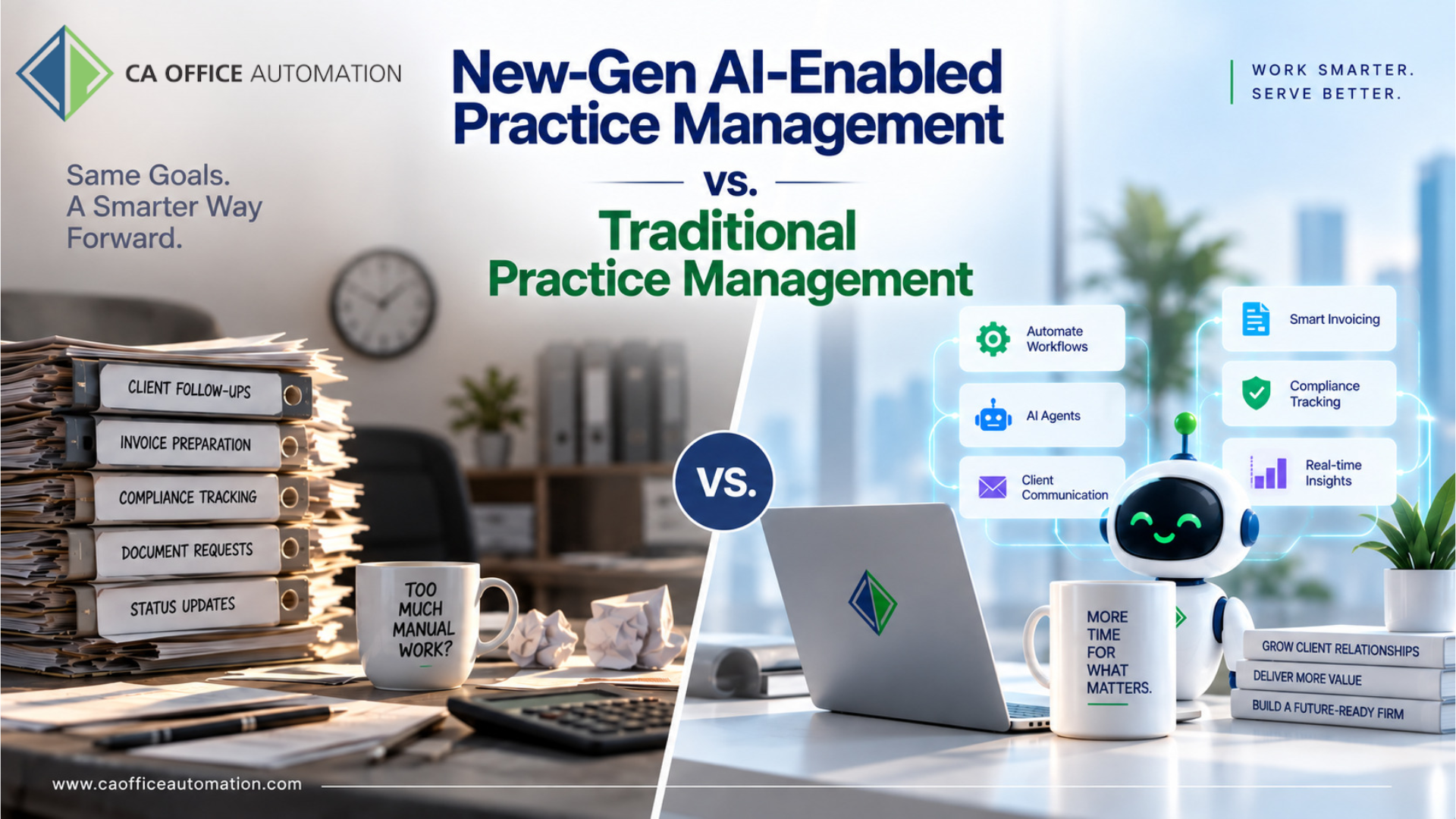
Accounting firms have always depended on technology.
First came accounting software. Then came spreadsheets. Then practice management systems. Then cloud applications and integrations.
But the next transformation is different.
AI is moving software from simply storing information to understanding information, generating insights, and taking action.
For accounting firms, this means the next generation of practice management will not be defined only by how many features a platform has. It will be defined by how intelligently those features work together.
A modern accounting firm needs more than task management, document storage, billing, payroll and reporting. It needs a connected digital environment where workflows can be automated, information can be understood by AI, and intelligent agents can assist professionals with everyday work.
This is where CA Office Automation (CAOA) moves beyond traditional practice management.
The Problem With Traditional Practice Management
A typical accounting firm manages a large amount of operational information every day:
- Client information
- Tasks and assignments
- Deadlines
- Documents
- Emails
- Approvals
- Billing
- Employee activities
- Compliance requirements
- Reports
- Client communication
Traditionally, these activities often exist across multiple applications. An employee may need to follow a long chain of steps: check the task, find the client, open the document, check the email, prepare a response, follow up, update the task, prepare the invoice, and then generate a report.
Each individual step may appear manageable. The problem is the fragmentation between them.
CAOA's technology workflow philosophy is built around reducing disconnected systems, repetitive activities, manual follow-ups and the number of places employees need to check.
The goal is not simply to replace several applications with one application. The goal is to create one intelligent operating environment for the accounting firm.
CAOA: Practice Management + Automation + AI
CA Office Automation combines practice management capabilities with workflow automation and AI agents in an integrated platform designed specifically for CPA, CA and accounting firms.
The platform brings together:
- Task Management
- Client Management
- Document Management
- Account Management
- Employee Management
- Payroll
- Business Analytics
- Automated Reporting
- Workflow Automation
- AI Agents
This integrated foundation is important because AI becomes much more useful when it can operate in the context of the firm's actual business information. Instead of asking AI about generic accounting information, professionals can increasingly ask questions about their own firm's data, documents, clients and workflows.
1
Task Management: From Task Tracking to Workflow Management
Task management is the operational foundation of an accounting practice. A modern platform should not merely show whether a task is completed. It should help answer:
- What needs to be done?
- Who is responsible?
- When is it due?
- What is pending?
- What is blocking completion?
- What should happen next?
- Which client requires attention?
CAOA's task management provides a unified environment for assigning, tracking and monitoring client work, deadlines, priorities and team workloads. But the bigger opportunity comes when task management connects with automation.
Task Completed
leads to
Billing Triggered
Task Pending
leads to
Follow-Up Triggered
Deadline Approaching
leads to
Notification Triggered
Approval Completed
leads to
Next Workflow Started
This transforms task management from a passive tracking system into an operational workflow engine.
2
Document Management: From Storage to Document Intelligence
Accounting firms process enormous volumes of documents: audit reports, bank statements, tax documents, financial statements, invoices, government forms, and client records.
Traditional document management answers one question: "Where is the document?"
AI-enabled document management can answer: "What does the document say?"
CAOA's Document Analysis Agent can analyze audit reports, bank statements, PDFs and Excel files, generate summaries and key points, answer questions about uploaded documents and support cross-document analysis.
Imagine uploading a lengthy financial document and asking: "What are the key issues relevant to this client?" Instead of manually reviewing every page first, the AI can help identify relevant information.
This does not replace professional judgment. It helps professionals reach the information they need faster.
3
Data Insights Agent: Talk to Your Practice Data
Accounting firms already possess valuable data. The challenge is turning that data into useful decisions.
Traditional reporting often requires a long manual process: select a module, apply filters, set a date range, generate a report, export it, review it in a spreadsheet, and finally find the answer.
An AI-enabled platform changes the interaction entirely. You can simply ask:
"Show all unpaid invoices."
"Which client tasks are overdue?"
"Show pending work for the audit team."
CAOA's Data Insights Agent is designed to allow users to query CAOA data using natural language without needing SQL or traditional filtering workflows.
Business intelligence becomes more accessible to partners, managers and professionals without requiring them to understand the underlying database structure.
4
Communication Agent: From Follow-Up Work to AI-Assisted Communication
Client communication is one of the most repetitive activities in accounting practices. Teams repeatedly send:
- Document reminders
- Payment reminders
- Compliance alerts
- Audit requests
- Follow-ups
- Client campaign messages
The traditional approach requires employees to identify recipients, prepare messages and send communications manually. A Communication Agent changes the workflow.
A professional could instruct the system: "Send reminders to clients whose work is pending from their side." The AI can assist with identifying relevant clients, selecting recipients, preparing drafts and supporting communication workflows.
CAOA's AI architecture includes communication-agent capabilities as part of its broader AI environment. The objective is not simply faster messaging. It is reducing the administrative work surrounding communication so professionals can focus on client relationships and higher-value activities.
5
Email AI Agent: Turn the Inbox Into an Intelligent Workflow
Email is still one of the most important communication channels for accounting firms. But an inbox can also become a hidden workflow system.
Consider what a single important client email requires: an attachment needs to be reviewed, a task needs to be created, a deadline needs to be tracked, someone needs to respond, and someone needs to follow up.
CAOA's Email AI Agent is designed to understand incoming emails, create inward entries and tasks, summarize content, classify attachments, draft responses based on predefined rules, route emails to appropriate team members and monitor follow-up deadlines.
Instead of treating email as a separate communication application, the platform connects email activity to the firm's operational workflow. Each email becomes understood, then acted upon.
6
AI Chat Agent: A New Interface for Accounting Professionals
Traditional software requires users to know where to click. AI introduces a different interface: ask.
A professional can ask an AI assistant an accounting, tax, compliance or drafting question and receive a context-aware response.
CAOA's AI Chat Agent supports accounting queries, audit and tax questions, compliance queries and professional drafting tasks, with context-aware interaction tailored to the practice environment.
This creates a more natural interaction with technology. Instead of searching for the right menu or report location, professionals can ask for the information they need and receive it directly.
7
AI Support Agent: Making the Platform Easier to Use
Training employees on a large practice management platform can take significant time. New employees may repeatedly ask the same questions:
- How do I create a task?
- How do I approve a task?
- Where do I configure billing?
- How do I generate a report?
- How do I update a client?
CAOA's Support Agent provides conversational, step-by-step guidance for using the platform and its workflows. Instead of searching manuals or waiting for assistance, users can interact with an intelligent in-application support layer.
Software support becomes part of the software itself. This creates an important shift: onboarding time drops, adoption improves, and the platform becomes easier to use at every level of the organization.
8
Automated Billing: When Work Triggers the Next Action
One of the clearest examples of intelligent workflow is billing automation. CAOA Auto Invoice can generate Proforma Invoices or Invoices based on predefined billing frequencies and task-related conditions. It supports monthly, quarterly, half-yearly and yearly billing cycles.
Billing can also be triggered based on:
- Specific dates
- Task status
- Number of days after a task status
- Company
- Tax configuration
- Reverse Charge
- Invoice type
Task Status = Completed + 5 Days
leads to
Invoice Generated Automatically
The functionality is also available across multi-employee and Infinite Task workflows.
This is a clear example of the difference between basic automation and intelligent practice management. The system does not merely store that a task was completed. The completion of the task can become the trigger for the next business process.
9
Secure and Governed AI
For accounting firms, AI adoption cannot be separated from data protection. Accounting practices manage sensitive information including:
- Financial information
- Client information
- Banking information
- Tax information
- Government identifiers
- Business documents
- Internal information
Simply connecting an external AI model to practice data may not be an appropriate approach for every workflow.
CAOA's current platform positioning includes built-in data masking, hierarchy controls and approval controls for AI use. The broader secure-AI architecture developed around CAOA's technology also supports context-aware masking and controlled AI processing, including support for cloud and local LLM deployments.
AI adoption should be governed AI adoption. The objective is not to give everyone unrestricted access to AI. It is to give the right people controlled access to the right intelligence within the right environment.
11
Business Analytics: From Historical Reporting to Active Intelligence
Analytics has traditionally been about looking backward: what happened last month, what was revenue, how many tasks were completed, which clients are overdue.
The next generation is more proactive. AI can help professionals ask forward-looking questions:
- What requires my attention now?
- Which clients have outstanding work?
- Where are operational bottlenecks developing?
- Which invoices remain unpaid?
CAOA combines business analytics with AI-driven data interaction, creating an environment where data can move from reporting toward decision support.
AI Agents as Digital Team Members
The most significant evolution is the movement from software to automation to AI assistant to AI agent.
An AI assistant generally helps a person. An AI agent is designed to help perform a defined business activity.
For an accounting firm, this can mean having specialized digital workers for:
- Data analysis
- Document analysis
- Communication
- Email processing
- Client support
- Workflow assistance
- Reporting
- Other defined practice processes
CAOA's current AI platform includes Data Insights, Document Analysis, Communication, Email, Chat and Support Agent capabilities.
The long-term opportunity is not to replace accounting professionals. It is to augment the firm's human workforce with digital workers who handle the repetitive, data-intensive and communication-heavy aspects of practice operations.
Human Expertise Still Matters
AI does not eliminate the need for professional judgment. Accounting professionals still provide:
- Interpretation
- Judgment
- Advisory
- Client relationships
- Risk assessment
- Professional responsibility
- Strategic decision-making
AI can take responsibility for much of the repetitive information processing surrounding that expertise. This creates a powerful operating model:
Human Professionals + AI Agents + Automated Workflows
Humans focus on what requires judgment. AI handles what can be understood, prepared, organized or automated. The practice management platform connects the two.
Why Accounting Firms Should Start Now
The competitive advantage of AI will not come simply from having access to an AI model. Almost everyone can access AI models.
The advantage will come from how deeply AI is integrated into the firm's operating model.
A firm using AI only to write occasional emails may gain some productivity. A firm where AI is connected across clients, tasks, documents, data, communication, billing and workflows can fundamentally change how the practice operates.
That is a much bigger opportunity.
CAOA: Building the Intelligent Practice
CA Office Automation brings practice management, workflow automation, documents, client management, billing, analytics and AI capabilities into one integrated environment designed for accounting professionals.
Its vision goes beyond automating individual tasks. It is about creating a digital operating environment for accounting firms where technology can:
- Manage work
- Understand information
- Connect data
- Assist professionals
- Automate repetitive processes
- Support communication
- Trigger business actions
- Act through intelligent AI agents
The Future Is Not Just Automated. It Is Intelligent.
The first generation of accounting automation focused on doing things faster. The next generation is about doing the right things intelligently.
The question for accounting firm leaders is therefore changing. It is no longer "Do we need AI?" The better question is: "Where should AI become part of the way our firm works?"
The firms that answer this question early can build a technology-enabled operating model where people spend less time managing administrative complexity and more time delivering professional value.
The future of accounting practice management is not another collection of software tools. It is an intelligent platform where people, workflows, data and AI agents work together. That is the Intelligent Practice.
"The firms that build intelligent practice management today will define the standard for the accounting profession tomorrow."
The CAOA Perspective
At CA Office Automation (CAOA), we believe the next generation of accounting practice is defined not by the number of features in a platform, but by how intelligently those features work together. Our integrated ERP brings together practice management, AI agents, workflow automation, document intelligence, communication tools and business analytics into one connected environment built specifically for CPA, CA and accounting firms.
The Intelligent Practice is not a distant ambition. It is being built today, one connected workflow at a time.
Final Thought
Accounting firms that integrate AI deeply into their operations - not just as a tool but as part of the firm's operating model - will be better positioned to serve clients, manage growth, and compete in an increasingly technology-driven profession.
The question is no longer whether AI belongs in accounting practice management. The question is how intentionally and how deeply it will be integrated.